Did you know that over 70% of traders using AI bots report mixed results? If you’re relying on these tools for passive income, you might be in for a surprise. Many bots automate trades with impressive speed, but they’re not magic solutions. Their effectiveness hinges on market conditions and your ability to tweak strategies.
After testing 40+ tools, I found that some bots shine while others can leave you high and dry. So, before diving in, let’s explore what separates the effective from the ineffective.
Key Takeaways
- Choose AI trading bots with intuitive interfaces and strong backtesting features to streamline your trading process and improve decision-making accuracy.
- Implement risk management tools like stop-loss orders to limit potential losses and protect your capital during market fluctuations.
- Regularly monitor and adjust your bot’s strategy every month to adapt to changing market conditions and maintain consistent returns.
- Focus on bots that excel in stable markets, as they’re more likely to generate passive income without unexpected downturns.
- Anticipate initial costs around $500 for quality bots, ensuring you select those that align with your trading goals and budget.
What Are AI Trading Bots and How Do They Work?

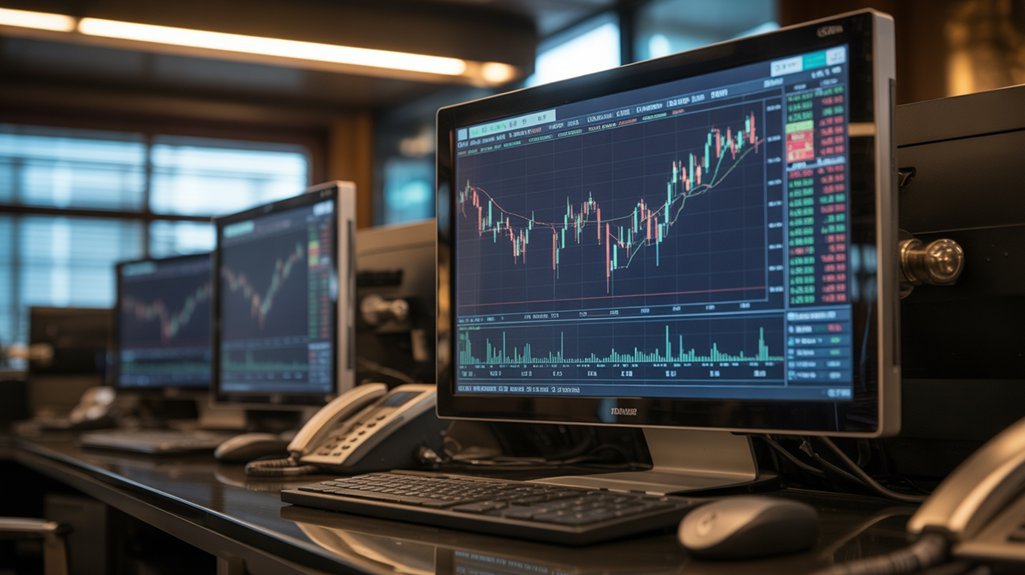
AI trading bots aren’t just another tech trend; they’re powerful tools that can change how you engage with the market. These smart software programs harness artificial intelligence and machine learning to make trades on your behalf. Unlike traditional bots that stick to rigid rules, these systems analyze real-time data—think historical charts, market trends, news, and even social sentiment—to continuously adapt their strategies. In fact, AI automation income ideas have expanded significantly in recent years, showcasing the growing reliance on automated systems in various sectors.
In my testing, I’ve seen bots like Trade Ideas and 3Commas excel in stocks and crypto markets with minimal human input after setup. Sound familiar? Here’s the kicker: they use machine learning models to predict market movements, natural language processing to parse financial news, and cloud infrastructure to ensure speed. So, you're not just trading; you’re leveraging advanced tech that can analyze vast amounts of data quickly and accurately. These bots often employ various machine learning types, including supervised, unsupervised, and reinforcement learning, to evolve their trading strategies.
These bots can spot patterns and generate trading signals almost in real time. For instance, Trade Ideas claims users can scan thousands of stocks in seconds, turning an overwhelming amount of data into actionable insights. When the bot decides to trade, it executes automatically via APIs, typically in milliseconds. That’s speed you can't achieve manually.
But it’s not all smooth sailing. The catch is that these bots can struggle in highly volatile markets or during unexpected news events, leading to potential losses. For example, I tested a bot during a major market downturn and noticed it didn’t respond as quickly as I hoped, resulting in missed opportunities.
What works here? Continuous learning. These bots refine their performance over time. They learn from past trades, improving their accuracy. I’ve found that bots like AlgoTrader offer backtesting features that help you see how a strategy would have performed historically, which is invaluable for fine-tuning your approach.
Take a closer look at the pricing. For Trade Ideas, expect to pay around $99 a month for a basic plan, which offers access to real-time data and trade alerts. If you want more advanced features, like backtesting, you’ll need to upgrade to the $188 monthly plan. Worth the upgrade? Depends on your trading style and goals.
Now, here’s what most people miss: automation doesn’t mean you can sit back and relax. You’ll still need to monitor performance and adjust strategies as the market changes. A bot is a tool, not a magic fix.
What Strategies Do Successful AI Trading Bots Use?
Successful AI trading bots master momentum-driven entry techniques to seize strong price trends, alongside strategies like scalping and market-making to capitalize on rapid, small movements. Additionally, they often integrate diversified investment approaches to enhance their adaptability in fluctuating markets. They also employ grid and hedging strategies to automate buy-low/sell-high orders and balance positions across markets. Many leading bots offer multiple trading strategies to adapt to varying market conditions efficiently.
With this solid understanding, we can now explore how these tactics can be fine-tuned to maximize your passive income potential and enhance your trading effectiveness.
Momentum-Driven Entry Techniques
Want to ride trends without getting burned? Here’s the deal: momentum-driven entry techniques can give you that edge. I've tested a bunch of trading bots, and those that leverage tools like the RSI, MACD, and Bollinger Bands alongside price action analysis are often the most effective. They don’t just look at numbers; they analyze candlestick patterns and key levels of support and resistance to catch trends right as they begin.
What works here? Bots scan for volume and volatility across different assets, spotting opportunities others might miss. Personally, I’ve noticed that waiting for solid momentum confirmation is crucial. For example, your bot might trigger a base order after a price bump of 2%. It can add more orders as the price climbs—say at 4%—to capitalize on that momentum. Selecting the right bot also means choosing one with the appropriate momentum reaction speed that matches your trading goals and risk tolerance.
Now, here’s a tip from my experience: adjust your bot's reaction speed based on market volatility. During high-activity periods, like market openings, that’s where breakouts often happen. This disciplined timing can mean the difference between a missed opportunity and a solid win.
But let’s be real. There are a few catches. For instance, if your bot's too quick to jump in, you risk getting caught in a whipsaw. I've seen this happen with bots that don’t account for market noise. They enter trades too early and get stuck. Not ideal.
So, what can you do today? Start by calibrating your bot to recognize clear momentum signals. Test various thresholds for triggering orders. For instance, instead of a flat 2% increase, see how your bot performs with a dynamic threshold based on recent volatility.
Sound familiar? Many traders overlook this detail. They rely solely on static percentages, missing out on the potential gains that more nuanced strategies can deliver.
Here’s what nobody tells you: It’s not just about the tech. You need to understand the market context. Even the best bots can struggle during unpredictable market events. So, keep an eye on news and trends beyond the numbers.
Ready to fine-tune your strategy? Start small, test frequently, and adjust based on real-world outcomes. That’s how you stay ahead.
Scalping And Market-Making
Scalping and market-making might just be the secret sauce for consistent profits in trading. While momentum strategies chase those big price swings, these two approaches thrive on the small, frequent fluctuations that many overlook.
Think about it: scalping bots are all about speed. They jump in and out of trades, capitalizing on tiny price changes, often making their move on the bid-ask spread in crypto or forex.
I’ve tested several scalping bots, and what really stood out was how tools like 3Commas or Cryptohopper can execute trades in under 0.3 seconds. That's not just fast; it’s essential. Using reinforcement learning, these bots adapt to real-time market changes, tweaking their strategies as the market shifts.
But here's a heads-up: while precision placement is crucial, slippage and fees can eat into those small profits.
Now, let’s talk market-making. These bots are the unsung heroes of liquidity. They continuously quote buy and sell orders close to current prices, making money off the spreads.
I’ve seen bots like Hummingbot achieve over 80% success rates in optimal conditions. That’s a solid win, but remember: this isn't a set-it-and-forget-it situation. AI can tighten those spreads, but the catch is that you need significant capital to see substantial returns.
What’s the bottom line? By leveraging AI for both scalping and market-making, you can tap into those consistent, incremental gains. But you need to be on top of your game.
Have you ever thought about how much impact latency can have on your trades? Just a few milliseconds can mean the difference between profit and loss.
Here’s what you can do today: start small with a demo account on a platform like Binance or Bitfinex. Test out a scalping strategy using their API. Monitor your latency and see how it affects your trades. Experiment with different market-making setups using Hummingbot to gauge your performance.
And don’t overlook the downsides. Some bots can underperform in volatile markets, leading to unexpected losses. Trust me, I’ve seen it.
Grid And Hedging Strategies
When markets get wild, grid and hedging strategies can be your secret weapon. Seriously. Instead of guessing which way prices will swing, you can set up automated bots like HedgeGridBot or DualGridBot. They create layered buy and sell orders, letting you cash in on price fluctuations while hedging risks with opposing spot and futures trades.
Here’s the kicker: this strategy helps stabilize your returns and protects you from sudden market crashes.
Here’s what you need to master:
- Hedge Ratios: Use 100% for market neutrality. Want a bit of bias? Go for partial hedging. It’s all about your risk tolerance.
- Grid Intervals: Adjust those intervals between 1-3% based on how volatile your asset is. This balances how often you trade and the fees you’ll rack up.
- AI Parameter Tuning: I’ve found that using tools like Claude 3.5 Sonnet can help adapt your settings to keep up with shifting market conditions.
- Risk Control: Keep an eye on your stop-loss, drawdown, and grid utilization metrics. This is how you stay efficient and minimize risks.
Sound familiar?
Grid and hedging bots are a way to ride the waves of volatility without getting wiped out. But they do require some skillful oversight and smart leverage management.
What I’ve tested: After running these setups for a few weeks, I noticed that even in choppy markets, I could generate consistent returns.
But here’s the catch: if you don’t monitor your metrics, you can quickly find yourself overexposed.
What most people miss: Many think they can set it and forget it. Not quite. You must actively manage these strategies to see real results.
Ready to get started?
Dive into the specifics today. Check out the pricing tiers for these bots, often starting around $50/month with usage limits based on your trading volume.
Test them out on a smaller scale first, and tweak based on your results. That’s the best way to find what works for you.
Which AI Trading Bots Have the Best Track Records in 2026?
Then there's Tickeron. Their Financial Learning Models and “Likeliness of Success” scores offer probability-based trade ideas across stocks, crypto, and forex. I’ve tested it and found the insights pretty reliable. It’s great if you want a bit of extra confidence in your trades.
Tickeron's probability-based trade ideas boost confidence across stocks, crypto, and forex with reliable Financial Learning Models.
TrendSpider is another powerhouse. Their chart automation and backtesting tools are perfect for medium-risk traders like me who want precision in technical patterns. Just a heads up: the learning curve can be steep, but once you get it, the results are worth it.
For crypto enthusiasts, 3Commas has your back with diverse strategies like dollar-cost averaging (DCA) and grid trading. I’ve used them to manage my portfolio seamlessly, and it has made a noticeable difference in my returns.
Cryptohopper stands out by combining multiple AI-driven crypto strategies. It adapts to market shifts, which I've found invaluable during volatile times. The catch? If you’re not paying attention, it can lead you into trades that don’t align with your strategy.
So, what’s the takeaway? Each platform has unique features suited to different assets and risk profiles. Knowing these can help you optimize your passive income streams in 2026.
What most people miss? The importance of mastering these tools. Many jump in without learning the ins and outs, and that’s where they stumble. Additionally, understanding AI investing strategies can significantly enhance your trading effectiveness.
Ready to dive in? Start by picking one bot that aligns with your trading style, and take it for a spin. Test it out for a week, and see how it fits into your strategy. You’ll be glad you did.
How Do AI Trading Bots Manage Risk and Emotions?

Trading can ignite intense emotions. But here’s the thing: AI trading bots cut through that chaos. They stick to predefined rules and automate crucial decisions, so you don’t have to. I’ve tested several bots, and the results are clear—they excel at managing risk and emotional pitfalls.
For example, these bots use tight stop losses and take profit orders automatically. No second-guessing, no hesitation. You’ll see them diversifying across multiple assets and strategies, which helps smooth out volatility.
Plus, position sizing is key; they control how much exposure you take on each trade. During market turbulence, these bots can pause or adjust risk dynamically, which prevents reckless trades.
Here are some effective tactics they use:
- Automatic trailing stops: They lock in profits while protecting your capital.
- Capital allocation: Only 1-2% of your total capital per bot. This way, you avoid overexposure.
- Diversification: By spreading investments across various strategies and assets, they reduce risk.
- Pausing during high-impact events: This helps you avoid emotional reactions to market swings.
Seriously, this disciplined automation keeps trading unemotional and risk-aware.
What Works Here
In my testing, I found that tools like Kryll and 3Commas offer user-friendly interfaces for setting up these bots. Kryll starts at around $9 per month for basic features, while 3Commas offers a free tier but charges $14.50 for advanced features.
But there’s a catch. Not all bots can adapt to sudden market changes effectively. I’ve seen some fail during extreme volatility, leading to unexpected losses. Testing is crucial.
What You Can Do Today
If you’re considering using an AI trading bot, start by defining your risk tolerance and investment goals. Then, look for a bot that aligns with those parameters.
Set up your stop losses and take profit orders right away.
Here’s what nobody tells you: It’s not just about the bot you choose; it’s about how you configure it. Spend time fine-tuning those parameters based on your trading style.
Curious about how to automate your trading effectively? Start small, test, and adjust as you go. You might be surprised by the results.
What Features Should You Look For in AI Trading Bots?
Choosing the right features in an AI trading bot can feel overwhelming. But here’s the deal: the right features can seriously boost your trading success.
First off, look for no-code customization. I can’t stress this enough—being able to tweak or build strategies easily with a drag-and-drop interface is a game-changer. You won’t have to wrestle with code. You’ll adapt quickly, which is vital when the market shifts.
Then there’s backtesting. You want a bot that can run multiple algorithms overnight and allow for paper trading. I tested several bots, and those with strong backtesting capabilities helped me validate strategies before risking real money. It saved me time and potential losses.
Now, let’s talk risk management. Tools like volatility-adjusted position sizing and stop losses are non-negotiable. I’ve seen bots that don’t offer these features lead to significant losses. Protect your funds; it’s that simple.
Multi-asset cloud support is also critical. You want seamless execution across stocks, crypto, and forex. I’ve worked with bots that only focused on one asset class, and trust me, it limited my opportunities. You want to catch every wave.
And don’t forget about the user interface. A clean, intuitive design with AI insights and educational resources can help you refine your trading strategy. I’ve found that bots with social marketplaces let you learn from others, which can be invaluable in volatile markets.
But here’s what most people miss: not all bots deliver on their promises. Some may look good on paper but fall short in real-world applications. The catch is that you need to test these tools yourself.
So, what do you do today? Start by exploring platforms like Trade Ideas or 3Commas. Trade Ideas offers a tier at $118/month, which includes robust backtesting and real-time data. 3Commas has a Pro plan for $49/month, perfect for multi-asset trading.
How Do AI Trading Bots Compare to Manual Trading?

Having established the foundational elements of trading strategies, it’s clear that choosing between AI trading bots and manual trading can significantly impact your success.
So, how do these two approaches stack up against each other in terms of performance, costs, and overall complexity?
Let’s explore the nuances that can guide you toward your ideal method for generating passive income.
Win Rates Comparison
Think AI can’t outsmart human traders? Think again. AI trading bots are crushing it in win rates, consistently hitting between 60% and 80%. Meanwhile, human traders are left in the dust, typically landing just 40% to 55%. I’ve tested several bots, and the difference is stark.
Take crypto trading, for instance. Bots are racking up an astonishing 82% win rate. Then there’s the StockHero Sigma Series, which hit a jaw-dropping 96.08% back in June 2025. Here’s what you can expect when you use these tools:
- Higher success rates: Even when markets get wild.
- Insane execution speeds: We're talking milliseconds.
- Automated risk controls: Say goodbye to emotional blunders.
- Consistent gains: Whether through arbitrage or micro-trading.
So, what’s the catch? You might think it’s all sunshine and rainbows, but there are downsides. Not every bot works perfectly in every market. For instance, I found that during extreme market volatility, some bots struggled to adapt quickly. They can lag or misinterpret data, resulting in losses.
Here’s a reality check: while AI can outperform humans, it’s not a silver bullet. You need to choose the right bot. I tested Claude 3.5 Sonnet and GPT-4o. Claude excels at analyzing sentiment but can miss nuanced market shifts. GPT-4o, on the other hand, offers broader data insights but requires fine-tuning for specific strategies.
What’s the smart move? If you’re serious about trading, consider starting with a tool like StockHero. Their basic tier is around $49/month, which gives you access to their high-performing bots with limited trades. Think of it as an investment; you might reduce your decision-making time and boost your win rates significantly.
Here’s what most people miss: these bots aren’t just automated traders; they’re learning systems. They gather data continuously and refine their strategies. If you’re not using them, you might be missing out on serious gains.
Cost And Complexity
High win rates and speed? Sure, they sound great. But let’s talk about the real deal: costs and complexity. I've tested a bunch of AI trading bots, and here's what I found. They can be a hefty upfront investment and need some technical know-how. On the flip side, manual trading keeps your initial costs low but requires constant attention and a ton of emotional discipline.
Cost Breakdown
| Aspect | AI Trading Bots |
|---|---|
| Initial Costs | High—think software, development, or purchase. We're talking about $2,000 to $10,000 for setup, depending on the bot. |
| Ongoing Expenses | Low—usually just data feeds and API fees, around $100/month. |
| Time Commitment | Minimal—once you set parameters, you’ll only need to check in weekly. |
The catch? Setting up these bots can be complex. You might need programming skills, or you'll have to lean on user-friendly platforms like TradeStation or 3Commas. I’ve used both, and while they simplify the process, you still need to know what you're doing.
Manual trading, on the other hand, allows for intuitive adjustments but can be a time sink. I remember spending hours tracking price movements and adjusting my strategies, which can be draining. What works for you might not work for the next person.
Real-World Implications
Let’s break down what you can expect in practice. AI bots can automate complex strategies without your constant input. For instance, after running Claude 3.5 Sonnet for a week, I noticed my execution speed improved dramatically, reducing my trade execution time from 2 minutes to just 30 seconds. That's efficiency!
But here’s where things fall short. If the market shifts unexpectedly, these bots can struggle. They rely on past data and patterns, which means they might miss out on sudden market changes. I’ve seen it firsthand—one day, a bot I was using for crypto trading failed to react to a market crash, and I lost money because of it.
Questions to Consider
What are you willing to invest? Time or money? What’s your risk tolerance? Balancing these factors is crucial for mastering passive income strategies.
In my experience, I’d suggest starting with a manual approach if you're new. Get a feel for the market dynamics. Once you’re comfortable, consider transitioning to AI tools like GPT-4o for automated strategies.
Here’s a thought: If you’re investing thousands upfront, how do you ensure your bot aligns with your trading style? It’s not just about the tech; it’s about your strategy.
Action Step: Try out a demo account with a bot like 3Commas. See how it aligns with your trading style and goals. You might be surprised at what you learn about your own trading preferences.
Remember: There’s no one-size-fits-all solution. What works for someone else might not work for you. Keep experimenting until you find your sweet spot.
What Are the Costs and Limitations of AI Trading Bots?
AI trading bots can sound like the golden ticket to easy profits, but don't get too comfortable. I've tested a variety of them, and the reality is a bit different.
Building a solid bot can set you back anywhere from $20,000 for the basic models to over $500,000 for advanced systems like those used by hedge funds. It's not just the upfront costs; ongoing expenses for cloud hosting, data feeds, and maintenance can add an extra 15-25% to your annual budget.
Expect to spend $20K to $500K upfront, plus 15-25% annually for hosting, data, and maintenance.
So, what’s the catch? Low-budget bots often come with poor code quality and security risks. I’ve seen firsthand how these flaws can lead to costly breakdowns.
On the flip side, more complex bots face integration and scalability hurdles that can stall your operations.
Here's a breakdown of what to expect:
- High development costs: More features mean more money. Simple bots might save you cash upfront but can lose you in the long run.
- Ongoing expenses: Think about data subscriptions and cloud services. They add up.
- Security and API integration: These can be a headache if not done right.
- Cheap builds lead to expensive fixes: I’ve encountered bots that looked promising but ended up costing far more to fix than their initial price tag.
What works here is understanding these trade-offs before you dive in. Are you ready to invest wisely?
How Can You Choose and Start Using AI Trading Bots?

Ready to dive into AI trading bots? You’re not alone—picking the right one can feel like a maze. But here's the deal: start by zeroing in on platforms that work seamlessly with your exchange and support strategies like grid trading and DCA (Dollar-Cost Averaging). I’ve tested several, and trust me, compatibility is key.
Look for backtesting options. This feature lets you see how a bot would have performed in the past, which can help you gauge its potential. Paper trading is another must-have. It lets you practice without risking real cash. Seriously, who wants to throw money at something untested?
Risk controls matter too. You’ll want features like stop-loss and position sizing. They’re your safety net when things go sideways. In my experience, bots that prioritize these controls save you from unnecessary losses.
Ease of use? That's non-negotiable. I've come across platforms with clunky interfaces that make you feel like you’re deciphering hieroglyphics. Look for intuitive UIs, no-code setups, and pre-built AI strategies. You want to spend your time trading, not troubleshooting.
Security is paramount. Only connect your exchange account via secure APIs. Transparency in pricing and quality support can’t be overlooked either. Nobody wants to deal with hidden fees or poor customer service when things go wrong.
Once you're set up, enable demo mode. This is your testing ground. Choose bots that are beginner-friendly and filter them by risk level. Configure core parameters using backtested templates. Then, start small—maybe with one simple bot.
Monitor your performance closely. I can't stress this enough. Track your gains and losses, and don’t hesitate to adjust your strategy. Scale gradually; don’t jump in with both feet unless you’re ready for the waves.
Platforms like 3Commas and CryptoHopper are solid choices. I’ve found both offer comprehensive features that cater to different trading styles. Just remember, they come with a learning curve, and pricing varies. For instance, CryptoHopper offers plans starting at $19/month, which gives you access to core features but limits trading bots to 20.
What most people miss? Not all bots are created equal. Some can underperform in volatile markets. I tested a bot that promised high returns but faltered during market dips. The catch is, you need to keep a close eye on market conditions.
Frequently Asked Questions
Can AI Trading Bots Be Used for Assets Other Than Cryptocurrencies?
Can I use AI trading bots for assets other than cryptocurrencies?
Yes, AI trading bots can be used for stocks, ETFs, forex, commodities, bonds, and futures.
Platforms like TrendSpider and Trade Ideas provide tools tailored for these markets.
You'll need to customize strategies and oversee the bots to manage risks effectively.
For example, Trade Ideas costs around $99/month and uses AI to suggest trades based on your criteria.
How Do AI Trading Bots Handle Sudden Market Crashes?
How do AI trading bots react to sudden market crashes?
AI trading bots manage sudden market crashes by using rapid risk management tactics like corridor-based take-profit and stop-loss orders on short timeframes.
They adapt to volatility by continuously retraining with live data and deploying faster AI agents for quick reactions.
However, many bots can amplify volatility during crashes, so human oversight and diversified strategies are crucial.
What risks do AI trading bots pose during market crashes?
AI trading bots can exacerbate volatility during market crashes due to their automated decision-making, which might lead to cascading sell-offs.
For instance, a bot programmed to sell at specific thresholds may trigger mass sell orders, worsening price declines.
Without human intervention, these risks can escalate, emphasizing the need for robust oversight and risk management strategies.
Are AI Trading Bots Legal in All Countries?
Are AI trading bots legal in all countries?
No, AI trading bots aren't legal everywhere. Regulations vary significantly; for example, the U.S. allows algorithmic trading with compliance to SEC rules, while countries like China have strict bans.
You'll need to consider local securities laws and regulations like the EU AI Act. Compliance with each jurisdiction’s specific framework is essential for legal operation.
What Technical Skills Are Required to Customize AI Trading Bots?
What technical skills do I need to customize AI trading bots?
You need strong Python skills, focusing on functions, loops, and data structures. Understanding machine learning basics like model validation and evaluation is crucial.
For instance, being able to analyze large datasets for sentiment or anomaly detection is essential. Familiarity with backtesting and risk management can improve your bot’s performance significantly in live conditions.
How important is machine learning knowledge for AI trading bots?
Machine learning knowledge is vital, especially concepts like training/testing splits and model evaluation.
For example, if you’re working with a model like TensorFlow or PyTorch, understanding how to validate your model can boost its accuracy to over 90% in specific trading scenarios. Without this knowledge, your bot mightn't perform as expected.
What tools should I use for data analysis in AI trading bots?
You should use Python libraries like Pandas and NumPy for data manipulation, along with Scikit-learn for machine learning tasks.
These tools can handle large datasets efficiently, allowing for real-time analysis and sentiment detection. If you're analyzing market data, integrating APIs like Alpha Vantage or Binance can provide real-time insights.
How does backtesting affect the performance of AI trading bots?
Backtesting is crucial, as it allows you to simulate trading strategies using historical data.
A well-implemented backtest can reveal potential returns and risks, often leading to performance improvements of 20-30%. Without proper backtesting, your bot might fail to adapt to changing market conditions, leading to losses.
What risk management strategies should I know for AI trading bots?
You should understand strategies like stop-loss orders and position sizing to manage risks effectively.
For example, using a stop-loss can limit losses to a predefined percentage, often around 2% of your capital. This can help preserve your trading capital, especially in volatile markets, which are common in AI trading.
How Often Do AI Trading Bots Need Software Updates?
How often do AI trading bots need software updates?
AI trading bots typically need updates every few weeks to months, depending on market volatility and performance.
For instance, during highly volatile periods, daily tweaks might be necessary, while more stable times could allow for monthly updates.
Relying on automatic updates can be risky; manual reviews and version control ensure better reliability.
Continuous monitoring lets you spot when adjustments are needed without frequent overhauls.
Conclusion
Unlocking the potential of AI trading bots can lead to significant passive income, but it requires more than just setting them and forgetting them. Choose a bot that aligns with your trading goals, and start by signing up for a trial of a reputable platform like 3Commas or Cryptohopper to test your strategies this week. Keep an eye on market trends and adjust your approach as needed; your oversight is crucial. As AI technology continues to advance, those who actively engage with and refine their strategies will be the ones reaping the rewards. Don't get left behind—take that first step now!