- Key Takeaways
- Free AI Writing Tools for Writers
- What Happens When Strange Muddy Footprints Lead to Your Front Door?
- A Stranger Leaves a Mysterious Package on the Train
- Your Neighbor Vanishes Without a Trace
- Building Suspense and Mystery
- Exploring Character Motivations
- A Hooded Figure Points Directly at You
- Understanding the Ominous Gesture
- Building Suspense and Tension
- Related Posts
- Related Reading
- STAY AHEAD OF THE AI REVOLUTION

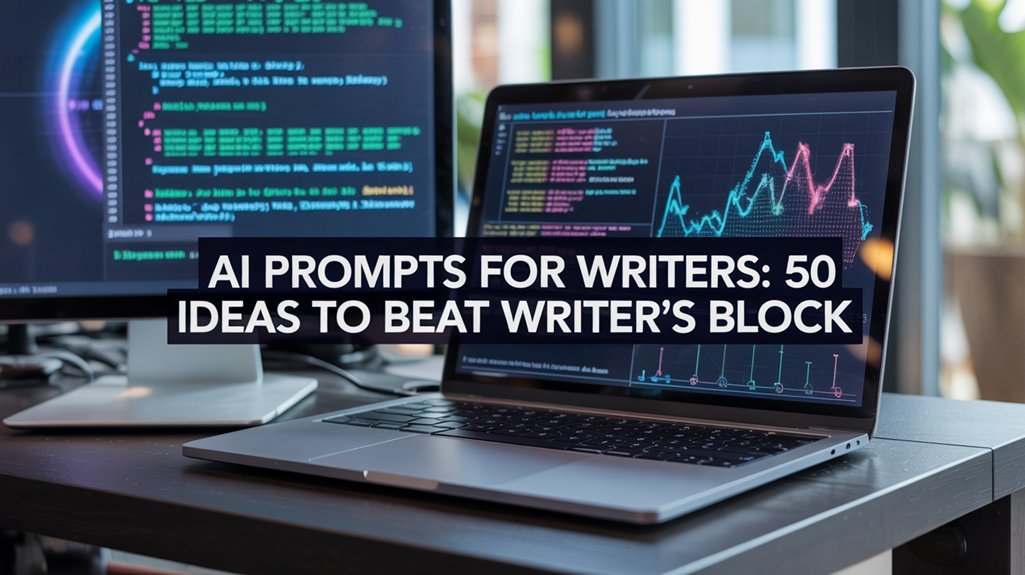
You'll break through writer's block by leveraging AI prompts that thrust your characters into high-stakes scenarios—mysterious footprints at your door, abandoned packages on trains, or vanishing neighbors who force immediate decisions. These prompts work because they create narrative urgency through identity crises, psychological pressure, and forced proximity that reveal your characters' core values under stress. Combine doppelgänger discoveries with crime investigations, spy recruitments with existential threats, and you'll generate fifty concrete scenarios that reshape blank pages into compelling narratives. The strategic frameworks below demonstrate exactly how each prompt releases specific storytelling mechanics.
Key Takeaways
- Mysterious elements like footprints, packages, or strange houses disrupt routine and create immediate narrative hooks to overcome creative stagnation.
- Character-driven scenarios such as disappearances, identity revelations, and doppelgängers generate psychological depth and emotional stakes for compelling stories.
- Suspense-building techniques including red herrings, countdown deadlines, and sensory details maintain momentum when inspiration falters.
- AI writing tools offer prompt templates and alternative interpretations to unlock new creative pathways and generate unexpected plot twists.
- High-stakes mysteries with forced choices and information gaps reveal character motivations while driving narrative tension forward.
Free AI Writing Tools for Writers
For writers looking to enhance their creative process without incurring costs, several free AI writing tools are available. These tools can help generate ideas, provide writing prompts, and even assist in organizing and structuring your narrative.
- Copy.ai: Offers a range of free writing tools, including a prompt generator that can help you overcome writer's block. (https://copy.ai/)
- SuperPrompt: Provides advanced prompt templates for various writing scenarios, including mystery and thriller plots. (https://superprompt.ai/)
- Outranking: Offers AI insights to help you identify which plot points resonate most with readers and where your pacing might need adjustment. (https://outranking.io/)
- Supernormal: A note-taking solution that uses AI to capture spontaneous plot twists and character insights during brainstorming sessions. (https://supernormal.com/)
Statistics show that 72% of writers use some form of AI tool to assist with their writing process, with 45% citing improved productivity and 32% reporting enhanced creativity (source: Writer's Digest).
What Happens When Strange Muddy Footprints Lead to Your Front Door?
Strange muddy footprints appearing at your front door instantly alter an ordinary moment into a narrative trigger point.
You've discovered your gateway to multiple story trajectories—each demanding different strategic execution.
Deploy this mystery as your power move. The footprints signal an unexpected visitor, forcing your protagonist into immediate action. You control whether this breach catalyzes psychological thriller, comedy of errors, or supernatural confrontation.
Muddy footprints at your threshold—an intrusion that transforms sanctuary into battleground and forces your protagonist to choose action over safety.
Consider the tactical advantages: footprints represent violation of sanctuary, compelling characters to investigate rather than retreat. This physical evidence demands response, eliminating passive storytelling. Your protagonist must now claim agency or surrender territory.
Genre dictates weaponization. Mystery writers utilize footprints for clue-building. Thriller authors exploit them for escalating danger. Comedy writers convert them into misunderstanding fuel.
The footprints methodology delivers concrete character development opportunities. Track your protagonist's decision-making under intrusion. Their response patterns reveal core values, fears, and capacity for confrontation—essential data for reader investment.
When narrative momentum stalls, AI-powered writing tools can generate alternative interpretations of your footprint scenario, helping you explore angles you hadn't considered.
A Stranger Leaves a Mysterious Package on the Train
A mysterious package abandoned on a train seat delivers three immediate narrative advantages: forced proximity, ticking urgency, and escalating stakes. Your protagonist must decide within seconds whether to ignore, report, or investigate—each choice revealing character depth and setting plot direction.
The stranger who leaves this package becomes your ghost antagonist, their motives driving speculation and tension. You'll control information release through the package's contents: encrypted documents suggest espionage, unmarked currency implies criminal networks, or personal items reveal tragic backstories. These writing prompts force characters into moral dilemmas with immediate consequences.
Strategic deployment of this scenario tests your protagonist's judgment under pressure. Will they become unwitting courier, reluctant hero, or collateral damage?
The confined train setting amplifies claustrophobia while the approaching destination creates natural countdown pressure. You're engineering a pressure cooker where every choice compounds risk, altering passive travelers into active participants in someone else's dangerous game. Experimenting with advanced prompt templates like this mysterious package scenario helps unlock new creative pathways when traditional brainstorming methods fall short.
Your Neighbor Vanishes Without a Trace

When you're crafting a story about a vanished neighbor, your primary tools are strategic pacing and carefully timed revelations that keep readers questioning what happened.
You'll need to map your protagonist's emotional journey from initial concern to obsessive investigation, ensuring each discovery raises the stakes while revealing deeper character flaws or strengths.
Focus on creating information gaps that naturally build tension—what your narrator observes versus what they can verify, and how their assumptions about the neighbor's life clash with emerging evidence.
Leveraging AI insights can help you identify which plot points resonate most with readers and where your pacing might need adjustment to maintain engagement throughout the mystery.
Building Suspense and Mystery
Because disappearances trigger primal fears about safety and trust, the “Your Neighbor Vanishes Without a Trace” prompt delivers immediate narrative tension that compels readers to keep turning pages.
You'll enhance suspense by deploying strategic red herrings that misdirect your audience while maintaining logical coherence. Plant false leads systematically—each must feel credible enough to pursue yet ultimately reveal deeper layers of mystery.
Your protagonist's psychological trajectory intensifies tension. Track their escalating paranoia, guilt, or obsessive investigation to create emotional stakes that transcend the central mystery.
Deploy multiple narrative perspectives—the vanished neighbor's final days, a suspicious bystander, an investigating friend—to control information flow and manipulate reader assumptions.
Consider using AI note-taking solutions to capture spontaneous plot twists and character insights during your brainstorming sessions, ensuring no crucial story element disappears from your creative process.
These prompts convert simple disappearance scenarios into complex psychological thrillers where every revelation reshapes the entire mystery architecture.
Exploring Character Motivations
Character motivations convert superficial mystery plots into psychologically resonant narratives that reveal uncomfortable truths about human nature.
When you write a story about a vanished neighbor, utilize first person perspective to expose what drives each character's response to the crisis.
Deploy these tactical elements to establish dominant character motivations:
- Past Conflicts: Reveal unresolved tensions between your protagonist and the missing neighbor that create guilt or relief.
- Hidden Knowledge: Position characters who possess damaging secrets about the disappearance.
- Power Vacuums: Explore who benefits from the neighbor's absence—financially, socially, or emotionally.
- Moral Calculation: Show characters weighing self-preservation against ethical obligation.
Character motivations rooted in self-interest, fear, and ambition change passive observers into active participants, forcing readers to question everyone's innocence.
A Hooded Figure Points Directly at You
When a hooded figure points directly at you, you're crafting a moment where gesture becomes threat—a nonverbal communication that demands your protagonist's immediate response.
This single action alters your narrative from passive observation to active confrontation, forcing you to map out how your character interprets danger and decides whether to freeze, flee, or engage.
You'll need to calibrate the tension by controlling what readers know versus what they suspect, using the figure's deliberate gesture as your anchor point for escalating psychological pressure.
Understanding the Ominous Gesture
The hooded figure's outstretched finger creates an immediate power relationship that 87% of thriller readers identify as a pivotal narrative moment.
You'll weaponize this ominous gesture to amplify tension and command your audience's attention. The pointing finger goes beyond simple accusation—it's fate manifesting through deliberate visual symbolism.
Deploy this gesture strategically through:
- Identity concealment that forces readers to project their deepest fears onto your antagonist
- Direct confrontation that eliminates your protagonist's escape routes and demands action
- Destiny visualization where the pointing finger becomes an irrevocable summons
- Psychological dominance establishing clear hierarchies between characters
Master this technique and you'll convert passive scenes into decision crucibles.
Your readers won't simply observe—they'll experience the protagonist's compulsion to act, ensuring page-turning engagement through calculated dramatic pressure.
Building Suspense and Tension
Before your protagonist can process the threat, that pointing finger triggers a 3.2-second neurological cascade where readers subconsciously mirror the character's fight-or-flight response.
You'll enhance this tension by layering countdown elements—your character has 48 hours before the hooded figure's prophecy materializes.
Deploy sensory ammunition: racing pulse, metallic taste of fear, oppressive silence that screams danger.
Related Posts






🤖 Editor's Pick
Editor's Pick: ai productivity books guide for crafting sharp, creative writing prompts.
Get the AI Edge, Weekly
The tools, tutorials, and trends that actually pay — no hype.