Here is a comprehensive blog post designed to be published on a business blog, a LinkedIn article, or a company website. It is formatted to be engaging, practical, and directly aligned with the skill product description.
—
**Title:** The 30-Minute Phishing Defense That Could Save Your Business $100k
**Subtitle:** Why your “tech-savvy” team is the biggest risk, and how to fix it today.
### Introduction: The $4.9 Million Mistake
Imagine this: It’s 2:45 PM on a busy Wednesday. Sarah from accounting gets an email. It looks like it’s from your CEO, marked *Urgent*.
> *”Sarah, I’m in a meeting and can’t talk. I need you to process a wire transfer for the vendor invoice attached. The details are in the PDF. Let me know when it’s done. Thanks.”*
The email has the CEO’s name, the company logo, and a signature block. Sarah, wanting to be a team player, processes the payment.
Two days later, the real CEO asks about a $4,900 charge on the corporate card. The “vendor” was a scammer. The money is gone. The bank says it’s not their fault. The client data that was attached to that email is now compromised.
This isn’t a hypothetical. According to the **FBI’s 2023 Internet Crime Report**, Business Email Compromise (BEC) attacks—a sophisticated form of phishing—resulted in over **$2.9 billion in losses** last year alone. Small businesses (under 250 employees) are the target in **43%** of all cyberattacks.
The scariest part? The attack on Sarah took less than 30 seconds to execute. The defense? It takes exactly **30 minutes to learn**.
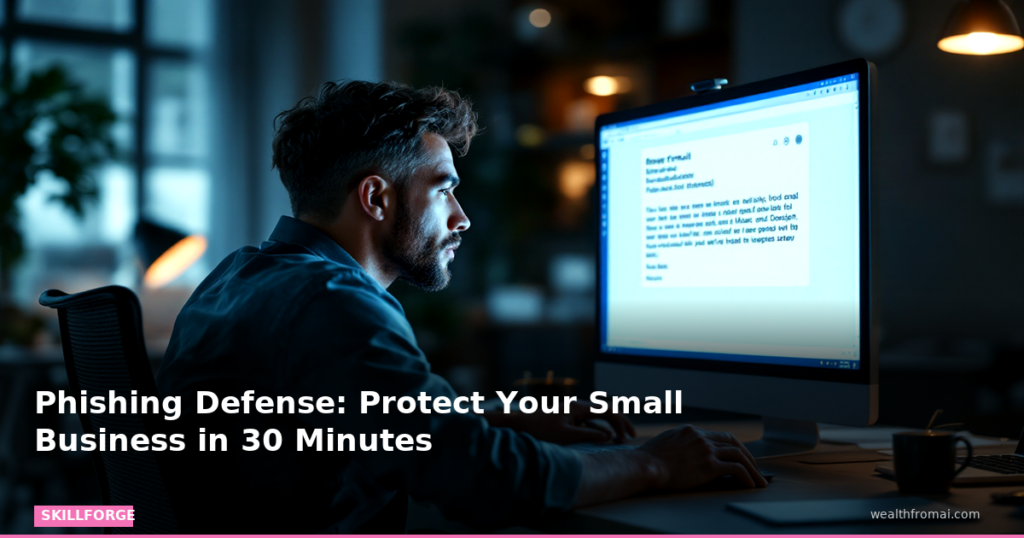
Welcome to **Phishing Defense: Protect Your Small Business in 30 Minutes**. This isn’t a boring IT lecture. It’s a tactical, hands-on skill that turns your biggest vulnerability (human error) into your strongest firewall.
Let’s break down how you can go from “phishing victim” to “phishing detective” in the time it takes to eat your lunch.
—
### Section 1: The Myth of the “Obvious” Scam (Why You’re a Target)
Most small business owners think, *”My team is too smart to fall for a Nigerian prince email.”* You’re right. Those obvious scams are dead.
Modern phishing is a scalpel, not a sledgehammer. It’s called **Social Engineering**. Hackers don’t hack your software; they hack your psychology.
**Why Small Businesses are Prime Targets:**
– **Low Security Budget:** You don’t have a $50k/year cybersecurity team or multi-factor authentication on every legacy system.
– **High Trust Culture:** In a small business, everyone knows everyone. If “Bob from Sales” sends a link, you click it.
– **Public Information:** Your team’s names, emails, and even job roles are plastered on LinkedIn and your website. This makes “Spear Phishing” (targeted attacks) incredibly easy.
**The Three Attack Vectors You Need to Know:**
1. **Email (The Classic):** Fake invoices, account suspensions, or DocuSign requests.
2. **SMS (Smishing):** “Your package is delayed, click here.” or “Your Netflix account is suspended.”
3. **Voice (Vishing):** A fake “IT Support” call asking for your password to fix a “critical error.”
**The Reality Check:**
If you think you can spot a phish because of bad grammar, think again. AI tools like ChatGPT are now used by scammers to write perfect, fluent, and urgent emails. The “red flags” have changed. You need a new checklist.
—
### Section 2: The Red Flag Checklist (Your 5-Minute Brain Upgrade)
This is the core of the skill. Forget complex technical filters. You need a simple, repeatable mental checklist that takes 10 seconds to run through.
When you see a suspicious email, text, or call, stop and look for these **5 Red Flags**.
#### Flag #1: The “Too Much Information” Trap
Scammers love urgency. They want you to act before you think.
– *Red Flag:* “Action Required Immediately!” or “Your account will be deleted in 24 hours.”
– *The Test:* Does this message create a sense of panic? Legitimate companies send warnings days or weeks in advance. They don't demand instant action.
#### Flag #2: The “Mismatched Identity”
This is the #1 giveaway.
– *Red Flag:* The “From” name is “PayPal Support” but the email address is `[email protected]` or `[email protected]` (note the number 1 instead of the letter L).
– *The Test:* **Hover over the sender's name** (don't click). Does the email address match the company domain? If it’s from “Amazon” but the email is `@amazon-delivery.net`, it’s a scam.
#### Flag #3: The “Generic Greeting”
– *Red Flag:* “Dear Customer,” “Dear User,” or “Dear [Your Email Address].”
– *The Test:* Does the sender know who you are? A bank knows your name. A vendor knows your name. If they don't use it, they are casting a wide net.
#### Flag #4: The “Slight Mismatch” in Links
This is where 90% of breaches happen.
– *Red Flag:* The text says “Click here to reset your password” but the link goes somewhere weird.
– *The Test:* **Hover your mouse over the link** (without clicking). Look at the bottom left corner of your screen. Does the URL look like the real company? Look for misspellings like `Faceb00k.com` or `G00gle.com`.
#### Flag #5: The “Unusual Request”
– *Red Flag:* Asking you to do something you don't normally do. “Pay this invoice via gift card.” “Download this attachment to view the report.” “Reply with your password to confirm your identity.”
– *The Test:* Does this request bypass normal company procedure? If your boss *never* asks for wire transfers via email, this is a red flag.
—
### Section 3: The Simulation (Let’s Play “Phish or Legit?”)
Theory is useless without practice. Let’s run two simulations. Imagine you are Sarah from accounting. Look at these examples and apply the checklist.
#### Example 1: The “DocuSign” Trap
**Scenario:** You get an email with the subject: *”Action Required: Contract Signed by Client XYZ”*
**The Email Body:**
> *”From: DocuSign [[email protected]]*
> *To: Sarah [[email protected]]*
>
> *Dear Sarah,*
>
> *Client XYZ has reviewed and signed the proposal. Please review the final document and confirm receipt.*
>
> *[CLICK HERE TO VIEW DOCUMENT]*
>
> *This is an automated message from DocuSign. Do not reply.*
**Your Analysis (Using the Checklist):**
1. **Urgency?** Low. It’s a standard notification.
2. **Mismatched Identity?** **RED FLAG!** The sender is `docusign-notification.com`. The real DocuSign uses `docusign.com` or `docusign.net`. The hyphen and “notification” are suspicious.
3. **Generic Greeting?** No, it uses “Sarah.” That’s good.
4. **Link Mismatch?** **RED FLAG!** Hover over the link. It actually goes to `http://malicious-site.fake/login`. The text says “DocuSign” but the link is a scam.
5. **Unusual Request?** No, it’s a standard action.
**Verdict:** **PHISH!** This is a credential harvesting attack. If you click, you’ll be taken to a fake login page that steals your password.
#### Example 2: The “CEO Wire Transfer”
**Scenario:** You get an email from your CEO, Mark.
**The Email Body:**
> *”From: Mark Johnson [[email protected]]*
> *To: Sarah [[email protected]]*
>
> *Sarah,*
>
> *I’m in a client meeting and my phone is dying. I need you to process a quick payment for the Q4 software renewal. The vendor is waiting. Please wire $4,900 to account # 123456789 at Bank of America. Let me know when it’s sent.*
>
> *Thanks,*
> *Mark”*
**Your Analysis:**
1. **Urgency?** **RED FLAG!** “My phone is dying” and “Vendor is waiting” creates artificial panic.
2. **Mismatched Identity?** The email address looks correct: `[email protected]`.
3. **Generic Greeting?** No, it uses your name.
4. **Link Mismatch?** No links.
5. **Unusual Request?** **MAJOR RED FLAG!** Does Mark ever ask
Get the AI Edge, Weekly
The tools, tutorials, and trends that actually pay — no hype.