
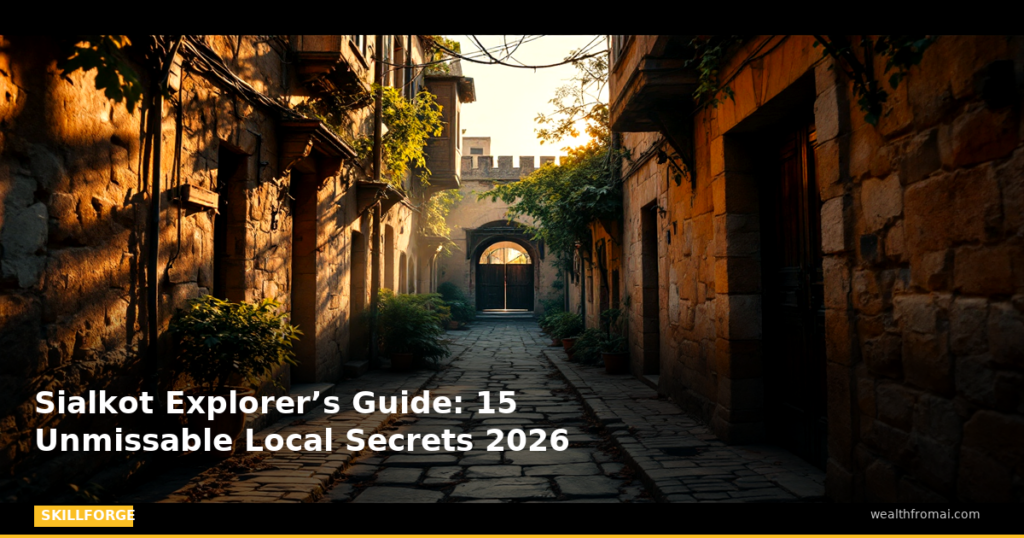
Here is a comprehensive blog post designed to meet your specifications.
—
# The Sialkot Explorer’s Guide: 15 Unmissable Local Secrets for 2026 (And Why You Need Them)
**Intro: The City of Steel, Spirit, and Secrets**
Let’s be honest. When you think of Pakistan, your mind likely jumps to the bustling energy of Karachi, the historical depth of Lahore, or the majestic valleys of the North. Sialkot? For most travelers, it is a name on a map—famous for its export-grade footballs, surgical instruments, and leather goods.
But if you are traveling in 2026, you are missing out on one of the most authentic, underrated, and vibrant urban experiences in South Asia if you skip this city.
Sialkot is a paradox. It is a city that works at the speed of light (its industrial output is staggering), yet it retains a soul of deep, traditional Punjabi hospitality. The problem is, the “real” Sialkot—the one that locals love—is hidden behind the main roads and the glossy storefronts. The street food that defines the city isn't on Google Maps. The best view of the city isn't from a hotel rooftop, but from a forgotten fort. The best souvenir isn't a football; it’s a hand-stitched experience you won't find anywhere else.
This is where the **Sialkot Explorer’s Guide: 15 Unmissable Local Secrets 2026** comes in. This isn't a generic travel brochure. It is a curated, insider’s map designed for the beginner traveler who wants to skip the tourist traps and dive straight into the heart of this industrial powerhouse.
In this post, I’m going to give you a taste of what that guide offers. We’ll break down the 15 secrets into digestible categories, show you how to build a perfect day trip or weekend adventure, and equip you with the cultural know-how to ensure your visit is respectful, safe, and unforgettable.
Ready to unlock Sialkot? Let’s go.
—
## Section 1: The Cultural Landmarks (That Tourists Miss)
Most visitors hit the Sialkot Fort (which is great) and the Allama Iqbal Manzil (a must). But the *secrets* lie in the shadows of these giants. The 2026 guide focuses on three specific spots that offer a deeper connection to the city’s history.
### Secret #1: The Forgotten Haveli of the “Sialkot School”
Hidden in the winding lanes of the old city, near the Sialkot Clock Tower, is a crumbling but majestic *haveli* (traditional mansion) that once housed a unique 19th-century art movement. While the famous “Sialkot School” of painting is often discussed in academic papers, the actual building where these artists worked is rarely visited.
**Insider Tip:** You won't find a sign. Look for the blue-tiled archway on Mohalla Khoja. Go early in the morning (7 AM) when the light hits the intricate brickwork. **Pro Tip from the Guide:** Ask the chai wallah at the corner for “Ustad ji ka ghar” (The Master’s house). He’ll point you to the door. The current residents are used to visitors and will often let you peek into the central courtyard for a small donation.
### Secret #2: The “Silent” Church of St. Joseph
Sialkot has a rich Christian history, and St. Joseph’s Cathedral is a landmark. But the secret is the smaller, older St. Joseph’s Church located behind the main Cathedral on Paris Road. Built in the 1850s, it is a quiet oasis. In 2026, a local conservation project has restored the original stained glass windows.
**Insider Tip:** Most tourists walk right past it to the bigger Cathedral. Go on a Sunday morning (9:30 AM). You can sit in the back pew and listen to the choir. The acoustics are stunning. **Practical Advice:** Dress modestly (cover shoulders and knees) and be respectful of the service. Photography is allowed, but no flash during the sermon.
### Secret #3: The View from the “Shahi” Qila’s Back Wall
Sialkot Fort (Qilla Mubarak) is well-known. But the secret is not the fort itself—it’s the path behind it. Walk around the back of the fort, past the main entrance, and you’ll find a dirt path leading to the old bastion wall.
**Insider Tip:** This spot offers a panoramic view of the entire city—the chaos of the industrial estates, the green of the fields, and the glint of the Chenab River in the distance. **Why it’s a secret:** No one goes here. It’s the perfect spot for a sunset picnic (bring your own snacks). **Safety Note:** The path can be uneven. Wear sturdy shoes and go with a friend.
—
## Section 2: Culinary and Market Hotspots (Where to Eat Like a Local)
Sialkot’s food scene is legendary, but it’s not about fancy restaurants. It’s about the street corners, the family-run dhabas, and the markets that smell of spices and fried dough. The 2026 guide cuts through the noise to give you the real deals.
### Secret #4: The “Banjara” Chicken at a Non-Descript Shop
Forget the famous “Sialkot Chicken” at the big names. The real secret is the “Banjara Chicken” at a tiny, no-name shop near the Wazirabad Road bus stop. The owner, a man named Tariq, has been grilling chicken over coals for 40 years. His marinade is a family secret—yogurt, papaya, and a blend of 15 spices.
**Insider Tip:** Go at 8 PM. The queue is long, but it moves fast. Order the “half chicken with naan and raita.” **Budget:** This will cost you less than $3 USD. **The Experience:** You eat standing up at a small metal table, with the traffic of Wazirabad Road buzzing past you. It’s perfect.
### Secret #5: The “Hidden” Bazaar for Surgical Steel
Sialkot is the world capital of surgical instruments. You can buy high-quality stainless steel scissors, forceps, and tweezers for a fraction of the international price. But the tourist shops on the main road are overpriced. The secret is the “Gali No. 3” in the Sialkot Industrial Estate.
**Insider Tip:** You need to go with a local or use the guide’s map. The shop is a small, unmarked room behind a larger factory. They sell “factory seconds”—perfectly good instruments with minor cosmetic flaws. **Practical Advice:** Bring cash. They don't take cards. A set of 5 high-quality scissors for embroidery or kitchen use will cost you about $10 USD.
### Secret #6: The “Patiala Shahi” Lassi at 6 AM
Every city in Punjab claims to have the best lassi. Sialkot’s secret is the “Patiala Shahi” lassi served at a shop called “Baba Ji” near the Khayaban-e-Sadiq. It is served in a massive clay bowl. It is thick, creamy, and laced with a hint of cardamom and saffron.
**Insider Tip:** Go at sunrise (5:30 AM). The shop opens at 5 AM and the lassi is made fresh. It is the breakfast of champions. **Why it’s a secret:** Tourists sleep in. Locals know this is the best start to a day of exploring.
### Secret #7: The Book Market for Football History
Sialkot’s football industry is famous, but the history is written in old books. Behind the main Saddar Bazaar, there is a small alley (Gali No. 2) that houses a book market every Friday. Here, you can find old magazines, pamphlets, and even books about the history of Sialkot’s football manufacturing.
**Insider Tip:** Look for the old man with the white beard and the stack of yellowed papers. He has a collection of 1970s era “Sialkot Football Club” memorabilia. **Practical Advice:** Bargain. Start at half the asking price.
—
## Section 3: Nature and Offbeat Adventures (Beyond the City Limits)
Sialkot is not just a city; it’s a gateway. The 2026 guide reveals the natural escapes that are just a short rickshaw ride away.
### Secret #8: The “Silent” Marsh of Head Marala
Head Marala is a popular picnic spot, but the secret is not the main barrage. It’s the “Silent Marsh” located a 15-minute walk upstream. It’s a wetland area where you can see migratory birds (in winter) and water buffalo bathing. There is no crowd. There is no noise.
**Insider Tip:** Go at 4 PM. The light is perfect for photography. Bring binoculars. **Safety Note:** Do not swim here. The currents are unpredictable. Stick to the bank.
### Secret #9: The Pottery Village of “Kala Shah Kaku”
Just 20 km from Sialkot, there is a small village called Kala Shah Kaku (not to be confused with
Get the AI Edge, Weekly
The tools, tutorials, and trends that actually pay — no hype.